

Lights
Microorganisms
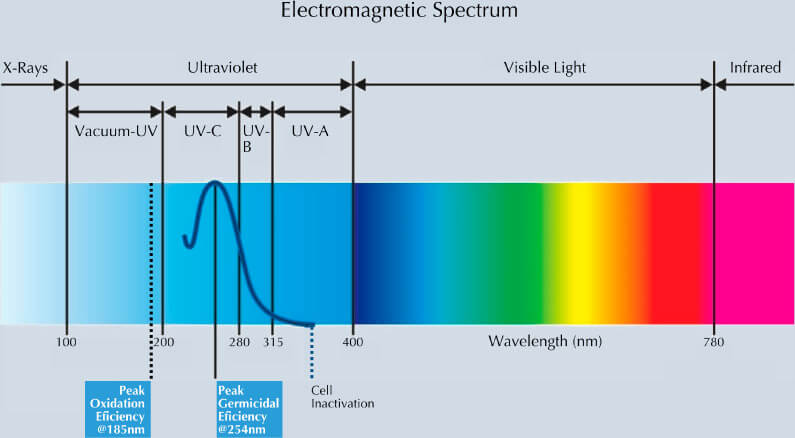
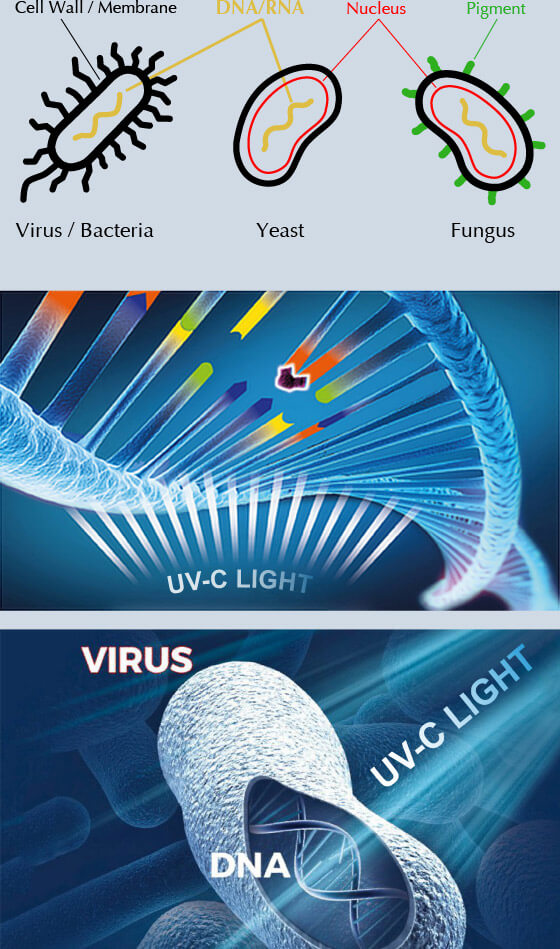
All living organisms contain DNA (deoxyribonucleic acid). DNA provides the mechanism for all functions . needed to sustain life. The UV light from 200 to 300 nm is easy to be absorbed by the cells,and the 253.7 nm has the strongest disinfection ability. The UV light penetrates the outer cell membranes of microorganisms, passes through the cell body, reaches the DNA and permanently alters the genetic material. The microorganisms are thereby destroyed in a non-chemical manner.
Ultraviolet disinfection is a purely physical process. Micro-organisms such as bacteria, viruses, yeast, etc. that are exposed to the effective UV-C radiation are inactivated within seconds. It does not add anything to the water, such as undesirable color, odor, taste or flavor, nor does it generate harmful byproducts. It is fast, efficient, effective, economical and environmentally friendly.
| Microorganisms | µW/cm2, 90% Destruction | µW/cm2, 99.9% Destruction | |
| Bacteria | Bacillus anthracis - Anthrax | 4,520 | 8,700 |
| Bacillus anthracis spores - Anthrax spores | 24,320 | 46,200 | |
| Bacillus magaterium sp. (spores) | 2,730 | 5,200 | |
| Bacillus magaterium sp. (veg.) | 1,300 | 2,500 | |
| Bacillus paratyphusus | 3,200 | 6,100 | |
| Bacillus subtilis spores | 11,600 | 22,000 | |
| Bacillus subtilis | 5,800 | 11,000 | |
| Clostridium tetani | 3,370 | 6,510 | |
| Corynebacterium diphtheriae | 2,140 | 4,100 | |
| Ebertelia typhosa | 3,000 | 6,600 | |
| Escherichia coli | 3,150 | 6,000 | |
| Leptospiracanicola - infectious Jaundice | 6,050 | 12,300 | |
| Microccocus candidus | 1,000 | 15,400 | |
| Microccocus sphaeroides | 6,200 | 10,000 | |
| Mycobacterium tuberculosis | 4,400 | 8,000 | |
| Neisseria catarrhalis | 3,000 | 6,600 | |
| Phytomonas tumefaciens | 5,500 | 10,500 | |
| Proteus vulgaris | 3,500 | 6,600 | |
| Pseudomonas aeruginosa | 4,000 | 7,600 | |
| Pseudomonas fluorescens | 3,200 | 6,100 | |
| Salmonella enteritidis | 2,150 | 4,100 | |
| Salmonela paratyphi - Enteric fever | 8,000 | 15,200 | |
| Salmonella typhosa - Typhoid fever | 19,700 | 26,400 | |
| Salmonella typhimurium | 2,420 | 6,160 | |
| Sarcina lutea | 2,200 | 4,200 | |
| Serratia marcescens | 1,700 | 3,400 | |
| Shigella dyseteriae - Dysentery | 1,680 | 3,400 | |
| Shigella flexneri - Dysentery | 4,400 | 6,160 | |
| Shigella paradysenteriae | 1,840 | 5,720 | |
| Spirillum rubrum | 2,600 | 6,600 | |
| Staphylococcus albus | 2,160 | 5,500 | |
| Staphylococcus aerius | 6,150 | 8,800 | |
| Staphylococcus hemolyticus | 2,000 | 3,800 | |
| Staphylococcus lactis | 6,150 | 8,800 | |
| Streptococcus viridans | 2,000 | 3,800 | |
| Vibrio comma - Cholera | 3,375 | 6,500 | |
| Molds | Aspergillius flavus | 4,520 | 8,700 |
| Aspergillius glaucus | 24,320 | 46,200 | |
| Aspergillius niger | 2,730 | 5,200 | |
| Mucor racemosus A | 1,300 | 2,500 | |
| Mucor racemosus B | 3,200 | 6,100 | |
| Oospora lactis | 11,600 | 22,000 | |
| Penicillium expansum | 5,800 | 11,000 | |
| Penicillium roqueforti | 3,370 | 6,510 | |
| Penicillium digitatum | 2,140 | 4,100 | |
| Rhisopus nigricans | 3,000 | 6,600 | |
| Protozoa | Chlorella Vulgaris | 6,050 | 12,300 |
| Nematode Eggs | 1,000 | 15,400 | |
| Paramecium | 6,200 | 10,000 | |
| Virus | Bacteriopfage - E. Coli | 3,000 | 6,600 |
| Infectious Hepatitis | 5,500 | 10,500 | |
| Influenza | 3,500 | 6,600 | |
| Poliovirus - Poliomyelitis | 4,000 | 7,600 | |
| Tobacco mosaic | 3,200 | 6,100 | |
| Yeast | Brewers yeast | 8,000 | 15,200 |
| Common yeast cake | 19,700 | 26,400 | |
| Saccharomyces carevisiae | 2,420 | 6,160 | |
| Saccharomyces ellipsoideus | 2,200 | 4,200 | |
| Saccharomyces spores | 1,700 | 3,400 | |
As a general guideline, the following are some typical UV transmission rates (UVT) :
- City water supplies : 85-98%
- Ground water (wells) : 90-95%
- Surface waters (lakes, rivers, etc) : 70-90%
- Other liquids : 1-99%
- De-ionized or Reverse Osmosis water : 95 -98%
| UVT(%) | 70 | 75 | 80 | 85 | 90 | 94 | 95 |
| Factor | 0.42 | 0.46 | 0.52 | 0.63 | 0.78 | 0.98 | Aqualight® Standard |
Find adjusted flow rate for UVT levels other than 95% :
- Select the "Factor" from the chart for UVT adjustment
- Divide 30mJ/cm2 by the "Factor" numbers for an adjusted dose
- From the systems graph of flow rates vs. UV dose, select the adjusted dose on the X-axis and follow the line to the point of intersection on the system model curve. Follow a horizontal line across to the line Y-axis to find the "Adjusted" flow rate
Find adjusted dosage :
- Select the "Factor" from chart for an UVT adjustment
- Select the flow rate on the Y-axis and follow a horizontal line to the system model curve and follow that line down to a dose number(mJ/cm2), then multiply the dose number by the selected "Factor" numbers to get an adjusted Dose
Find appropriate system :
- Select the "Factor" from chart for an UVT adjustment
- Divide the manufacturer's dose standard (or NSF standard) by the selected factor numbers for an adjusted dose
- Select the follow rate on your request from the Y-axis and the adjusted dose on the X-axis to get your system model (recommend a larger system if the selected point between two curves).
- No chemicals added
- No environmental problems
- No by-products that might endanger health
- No reaction tanks or secondary pumps
- Micro-organisms inactivated within seconds
- Minimum operating costs
- Maximum operating safety
- Modular system for adaptability
- Water retains its natural flavor and smell
